Vision-Force-Action Model: Why Force Guides Robots
Eka Robotics' new funding puts attention on vision-force-action models. Here is what force sensing changes, and what the company's claims do not prove.
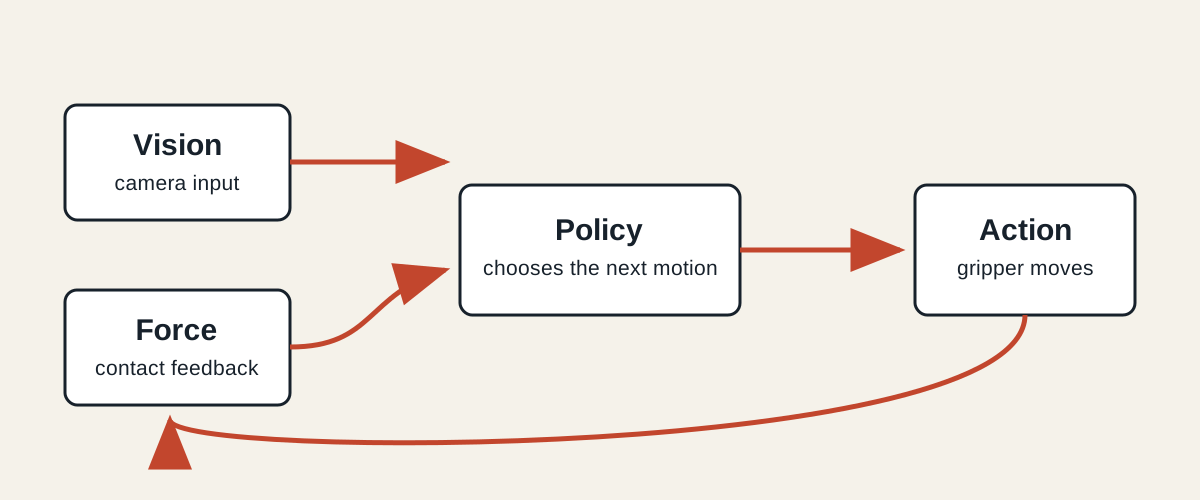
A vision-force-action model uses what a robot sees and feels while touching an object to choose its next movement. Eka Robotics said its VFA approach was central to a $150 million Series A announced on October 20. Contact can expose a limit in a manipulation demo: a cable resists insertion, a grasp slips, or a soft item deforms.[1]
Eka calls its approach VFA, short for vision-force-action. This is not a new robot model for sale. Eka has not published a common benchmark, customer deployment result, or detailed reliability data. The company and its investors describe an architecture, not demonstrated production performance.[1]
What is a vision-force-action model?
A vision-force-action model combines visual input with force feedback and uses both to choose the next robot movement. Vision can locate an object. Force can reveal resistance, slipping, or contact that the camera misses. Eka and its investors describe VFA as a way to make contact part of the controller's information.[1]
That distinction is easiest to see with an insertion task. A camera may show that a connector sits near a socket. It cannot always tell whether the connector has met resistance, tilted, or fully seated. A force signal can change the next motion while the action is still underway. a16z describes this as using resistance during insertion to alter motion instead of treating it only as an error condition.[2]
The word "model" can obscure the rest of the stack. Eka's claims cover training, sensing, control, and robot hardware together. That differs from a software layer vendors attach to any arm or gripper. a16z says Eka designs the sensing, controller, model, and hardware together.[2]
How does force feedback change robot manipulation?
Force feedback can let a robot react to a physical mismatch that visual perception alone does not resolve. It can support a correction when a grasp begins to slip or a part meets unexpected resistance. The result still depends on sensor quality, control latency, mechanics, and the particular task.[2]
Consider three ordinary contact problems:
| Contact problem | What a camera may show | What force feedback may add |
|---|---|---|
| Grasping a soft item | Object location and shape | Whether grip pressure is compressing or losing the item |
| Inserting a cable | Position near the port | Resistance or a partial insertion |
| Handling a shifting object | A change in visible pose | A load change before the object visibly moves |
The table describes the information VFA systems aim to use. It does not establish that any one system will solve each case. F-Prime says Eka applies the approach to contact-rich manipulation and uses a proprietary force sensing approach. Its article does not publish sensor accuracy, task success rates, or a test protocol.[3]
"Contact with a surface can help locate an object," a16z wrote in its announcement of the investment.[2]
That statement is a design rationale, not a field result. Buyers need to know how often the robot completes a specified task at the required speed, across the materials and failures on the actual line.
Why does Eka train in simulation?
Eka says it trains through large-scale reinforcement learning in simulation. It varies objects, environments, and physical conditions before transferring the learned policy to physical robots. The company says simulation can generate thousands of hours of robot experience in minutes.[1]
Reinforcement learning rewards actions that meet a stated objective. In a manipulation setting, a policy can try motions, receive a reward or penalty, and adjust after repeated attempts. Simulation makes those attempts cheaper and safer than repeating them on physical hardware. It also leaves a hard problem: the simulated physics, sensors, and robot must transfer well enough to the real setup.
Show data
| Eka reported rate | 1500 |
|---|---|
| Company-stated human baseline | 600 |
Eka reports 1,500 operations per hour when picking a wide variety of objects outside its training distribution. It places a human baseline at about 600 operations per hour.[1] The announcement does not name the objects, explain error counting, state run duration, or say whether the task included loading, inspection, recovery, and handoff.
What does Eka's $150 million round actually establish?
The funding round establishes that Eka says it raised $150 million, led by a16z and F-Prime, with the stated purpose of scaling its technology and customer deployments. It does not independently validate the 1,500 operations per hour claim or prove that the approach is ready for a specific factory job.[1]
F-Prime frames Eka's technical bet as a response to a tradeoff between general behavior and commercial speed and reliability. An investor in the round wrote that view, so readers should treat it as an investment thesis, not an outside assessment.[3]
The timing is clear. The International Federation of Robotics reported 5 million operational industrial robots in 2025 and more than 600,000 installations during that year. Those totals count industrial robots as a category. They do not describe Eka deployments or prove that a VFA system works in production.[4]
- 2026-04: Eka publicly launches its Vision-Force-Action approach, according to F-Prime.
- 2026-10-20: Eka announces a $150 million Series A led by a16z and F-Prime.
- 2026-10-20: Eka says the funds will help scale its technology and customer deployments.
What should a prospective user ask Eka?
A prospective user should ask for task-specific evidence, not a broad claim of generality. The cited announcements do not disclose a customer name, a production uptime figure, a task success rate, an error taxonomy, or a common external benchmark.[1]
Ask for the task definition first. "Pick unfamiliar objects" may describe a useful capability, but it does not identify object condition, bin geometry, cycle boundaries, intervention rules, or acceptable damage. Then ask for measurements under the same operating constraints the deployment will face.
1. What objects, materials, and tolerances did the test use? 2. What counts as success, failure, recovery, and human intervention? 3. What rate did the system sustain over a full operating period? 4. Which sensors and grippers does it need, and which changes require retraining or integration work?
Our view: force belongs in the conversation whenever a task depends on contact. Eka's public material makes a coherent technical case for using it. The next evidence readers need is narrower and less glamorous: repeatable task results, published test conditions, and named operating deployments.
For a broader view of industrial robot counts, see our explainer on robot density. For the difference between industrial and service categories, read what counts as a service robot. Our warehouse humanoid explainer covers a different deployment problem: adapting a human-oriented site instead of proving one contact task.
Vision-force-action models: common questions
What does vision-force-action mean in robotics?
Vision-force-action refers to a control approach that uses visual perception and physical force feedback to choose a robot's next movement. It aims to use contact information, such as resistance or slipping, while the task is underway.
Is Eka's VFA model an independently benchmarked product?
The cited public material contains Eka's and its investors' descriptions of the approach. It does not provide a shared independent benchmark, published customer result, or task-specific reliability dataset.
Why is force sensing useful for robot manipulation?
A camera can show where an object is, while force feedback can detect resistance, load, or contact. A controller may use that extra information to correct a movement during grasping or insertion.
Does a $150 million funding round prove a robot works in production?
No. The round establishes financing and investor support. Production readiness needs separate evidence such as task success rates, uptime, intervention data, test conditions, and named deployment results.
Sources
- https://ekarobotics.com/blog/eka-robotics-raises-150m-to-build-superhuman-intelligence-for-the-physical-world
- https://a16z.com/announcement/investing-in-eka-robotics
- https://www.fprimecapital.com/blog/eka-robotics-the-path-to-superhuman-general-purpose-robots/
- https://ifr.org/ifr-press-releases/news/five-million-robots-now-operate-in-factories-globally