Digit 5 Fast Charging: What a 10:1 Ratio Means
Agility says Digit 5 runs for 90 minutes and recharges in nine. The ratio could reduce charging downtime, but it is not proof of warehouse uptime.
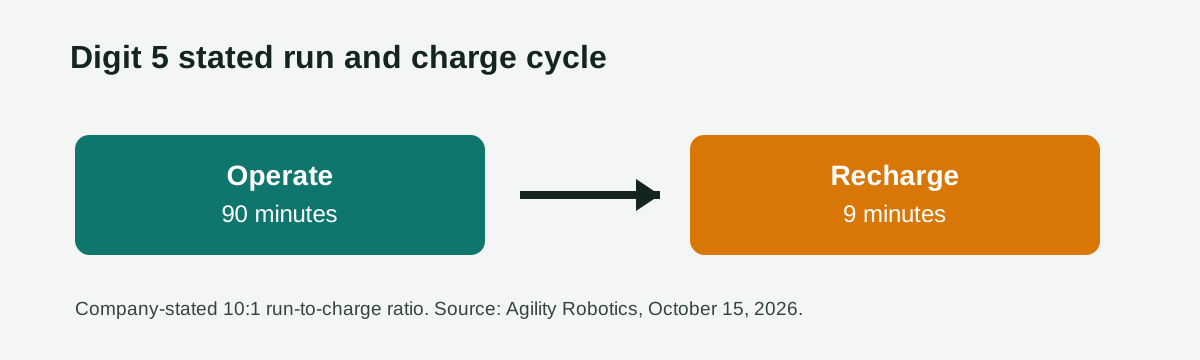
Digit 5 fast charging means a stated 90 minutes of runtime followed by a nine-minute recharge. Agility Robotics says that creates a 10:1 run-to-charge ratio and supports more than 20 productive hours in a 24-hour day. It is a manufacturer target for a robot expected to reach early customers in the first half of 2027, not field-verified fleet uptime.[1]
Agility named Nyobolt as Digit 5's battery technology provider on October 15. The announcement gives a buyer a useful operating rhythm, but leaves out pack capacity, charger power, charge-state window, thermal limits, and cycle-life test results. Those omissions matter because a fast battery recharge is only one part of a working cell.
What does Digit 5's 10:1 run-to-charge ratio mean?
A 10:1 run-to-charge ratio describes time spent running relative to time spent charging. For Digit 5, Agility says the robot will operate for 90 minutes before a nine-minute recharge. That is a battery-cycle claim. It does not include travel to a charger, waiting for access, task pauses, or recovery after a fault.[1]
| Item | Agility's stated figure | What the figure does not establish |
|---|---|---|
| Runtime | 90 minutes | Useful work completed during that period |
| Recharge time | 9 minutes | Charger availability or charge-state range |
| Run-to-charge ratio | 10:1 | Whole-system availability |
| Work in 24 hours | More than 20 hours | Site-specific productive output |
*Source: Agility Robotics' October 15, 2026 announcement.[1]*
Agility's product page repeats the 10:1 ratio and the 20-hours-in-24-hours figure. Agility has also said the earlier Digit 4 ratio was 2:1.[1] Those are vendor claims, so treat them as the design target until operators publish comparable records.
Show data
| Runtime before recharge | 90 |
|---|---|
| Recharge time | 9 |
Why does faster charging matter for a humanoid robot?
Faster charging can reduce one predictable source of idle time. For a robot intended for warehouse, distribution, and manufacturing sites, a shorter planned charging stop may make it easier to cover more shifts with one unit. It does not make the robot faster at its assigned task or prove that it can work unattended.
The power system needs to move energy into the pack quickly without causing unacceptable heat, wear, or operational constraints. Nyobolt says its technology combines battery-management software, pack and power electronics, proprietary anode materials, and cells tuned for high power. That describes Nyobolt's approach, not a disclosed Digit 5 pack specification or a published validation result for Digit 5.[3]
Agility says Digit 5 will have a 23 kg payload and 2.2 m reach, alongside the stated battery figures.[2] Those specifications may affect what the robot can do between charges. They do not answer the harder buyer question: what completed-cycle count will the system deliver in a normal shift?
A short recharge only improves a deployment when the robot can return to useful work without creating a new bottleneck at the charging dock.
For the wider context on bounded warehouse work, see our explainer on what humanoid robots in warehouses do. A charging claim does not change the distinction between a controlled workflow and general warehouse autonomy.
Why is fast charging not the same as uptime?
Uptime measures whether the full robot system is available to perform its assigned job. A nine-minute battery recharge can help, but charging is only one downtime category. Fleet uptime also depends on charging access, navigation, software behavior, task variation, safety stops, repairs, and the people who reset or supervise the system.
Agility frames the more-than-20-hours figure as productive work, while its product material says Digit will use fleet management software with warehouse and manufacturing systems.[1][2] Neither source publishes a field dataset that separates moving, working, charging, waiting, safety stops, planned maintenance, and unplanned faults. That makes the headline useful for planning questions, not for a completed business case.
The distinction is familiar in industrial automation. Battery charge does not produce output when an upstream station is empty, a downstream conveyor stops, or a human must clear an exception. Robot density has a similar limit: a count can show adoption without measuring useful output.
- 2026-10-15: Agility identifies Nyobolt as the battery technology provider for Digit 5.[1]
- 2027-H1: Agility expects early access to Digit 5 equipped with Nyobolt technology to begin.[1]
- 2027-H2: Agility says availability will increase over the following six to nine months.[1]
What should an operator ask before relying on the claim?
An operator should ask for a shift-level record that separates battery time from task time. The record should show completed units, time at the charger, charger queue time, interventions, recoveries, safety stops, and maintenance. It should cover ordinary and peak conditions at the actual site, not a short demonstration.
Ask Agility and the integrator for these details:
1. What charge-state window produces the stated nine-minute recharge? 2. What charger count does the fleet need for the planned robot count and shift pattern? 3. Does the stated runtime include travel, manipulation, waiting, and safety behavior for the intended workflow? 4. What happens when another robot uses the charger, the robot cannot dock, or the task stops midway through a cycle? 5. What battery and charging performance remains after the expected service life?
Agility says its fleet platform reports KPIs including uptime, throughput, and mean time between incidents.[2] Those are the right categories to request, but the company has not published Digit 5 field results for them. A serious pilot should make the definitions and raw shift logs part of the acceptance criteria.
The practical reading of Digit 5's charging claim
Digit 5's stated 10:1 run-to-charge ratio could reduce a visible limitation of mobile humanoids: time spent parked for energy. The October partnership notice also identifies who will supply the battery technology. Neither point establishes commercial productivity, reliability, or total cost at a warehouse.
Our view: this is a meaningful specification to test, not a result to assume. The first useful evidence will be site records showing whether a Digit 5 fleet finishes assigned work through a full operating day, including charging, exceptions, and maintenance. Until then, the ratio belongs in a pilot model beside the rest of the cell, not at the top of an ROI spreadsheet.
Digit 5 fast charging: common questions
How long does Digit 5 run before charging?
Agility states that Digit 5 will run for 90 minutes before a recharge. The company says the recharge takes nine minutes.[1]
What does Digit 5's 10:1 run-to-charge ratio mean?
It means Agility states 10 minutes of runtime for each minute of charging, based on 90 minutes of runtime and nine minutes of recharge time. It does not measure total site uptime.[1]
Does fast charging prove a humanoid robot can work for 20 hours a day?
No. Agility's more-than-20-hours claim is a manufacturer target. A site must also account for task availability, travel, charger access, faults, maintenance, and human intervention.[1]
When will Digit 5 with Nyobolt's battery technology be available?
Agility expects early access in the first half of 2027, followed by increasing availability over the next six to nine months.[1]
Sources
- https://www.agilityrobotics.com/content/agility-robotics-selects-nyobolt-as-its-ultra-fast-charging-battery-technology-partner-for-digit-5
- https://www.agilityrobotics.com/solutions/digit-5
- https://nyobolt.com/technology/